An Ethiopian coffee ceremony is coffee made for company, in front of the people who will drink it: the host starts with raw green beans and ends, three rounds later, with a cup poured as a blessing. The Eritrean coffee ceremony follows the same pattern, with its own words for the cups and some of the tools. At our Ethiopian and Eritrean restaurant near SeaWorld in Orlando, you can order the ceremony any time we are open, with a two-cup serving at $8.
What is an Ethiopian coffee ceremony?
An Ethiopian coffee ceremony is coffee prepared from scratch for whoever is in the house, and in many homes it happens every day as a way of welcoming people. Coffee is buna (also written bunna) in Amharic and bun in Tigrinya. The ceremony is as much about conversation as it is about the drink.
The host is traditionally a woman of the family, though in Eritrea men sometimes step in when no women are present. The eldest guest or the guest of honor is often served first. The ceremony remains a gathering point for families in the diaspora.
What happens during the ceremony, step by step?
The ceremony takes coffee from raw bean to cup in one sitting, with every stage in view of the guests.
- Fresh-cut grass goes down on the floor, sometimes with flowers or herbs mixed in, and incense is lit.
- The green beans are rinsed so that bits of husk and grit do not reach the pan.
- The beans are roasted in a long-handled pan over charcoal or a small flame, stirred constantly until they reach anywhere from medium brown to dark and glossy.
- The freshly roasted beans, still smoking, are offered to every guest in turn, and each one waves the smoke toward their face. One Eritrean account describes guests answering with a blessing for the house.
- The roasted beans are pounded by hand in a mortar and pestle, the mukecha and zenezena in Amharic.
- The grounds are boiled with water in the jebena, the clay coffee pot, then cooled, boiled again and left to settle. A filter, often of horsehair, sits in the spout to hold back the grounds.
- With the pot raised about a foot, the host keeps one stream running from cup to cup. The cups are small and handleless: sini in Ethiopia, finjal in Eritrea.
Snacks go around during the ceremony, sometimes from the very start: a bread such as himbasha, roasted barley, toasted seeds or popcorn.
What comes to your table at Selam?
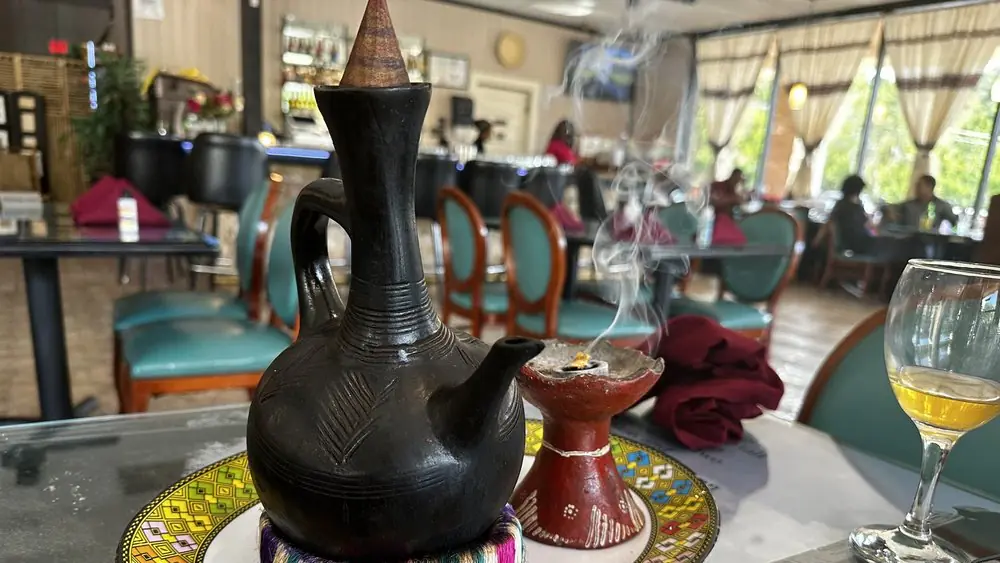
At Selam the ceremony arrives as a set on a round, patterned platter: a black clay jebena with a small woven cap on its neck, resting on a woven ring; a clay incense burner, lit so smoke drifts across the table; and small handleless sini cups, two with the Mini House or four with the Big House, with spoons and sugar on the side. The coffee is poured from the jebena at your table.
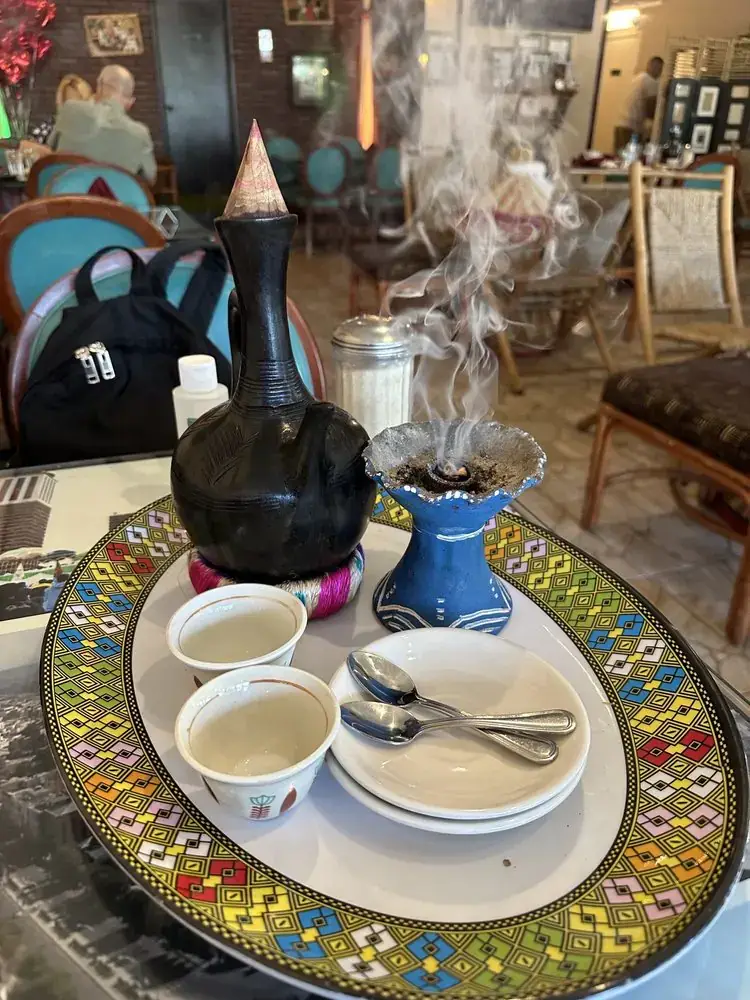
Photo: Giorgi B. on Yelp.
What are the three rounds called?
In Amharic the three rounds are abol, tona and baraka (also spelled bereka); in Tigrinya they are awel, kalay (also written kale'i) and bereka. Usage varies even within Eritrea, where one source calls the first round abol as well. In an anthropologist's essay in the UNESCO Courier, Éloi Ficquet gives the meanings of abol, tona and baraka as "first", "second" and "blessing".
The grounds are brewed again with fresh water for the second and third rounds, so each round is lighter than the one before; some hosts stir in a little ground coffee kept back from the same roast. The third round is the blessing, offered for the household and everyone gathered around the pot.
Why is incense burned during a coffee ceremony?
Incense is burned so its scent fills the room during the ceremony, though writers give different reasons for it. Eritrean accounts name frankincense. The greenery has a meaning too: Ficquet writes that "fresh herbs and flowers are scattered on the ground as a sign of welcome."
At Selam, a 2023 Vittles & Nosh review recalled being "greeted by our server and the smell of frankincense" on arrival.
How is the Eritrean coffee ceremony different?
The Eritrean coffee ceremony shares its core with the Ethiopian one, from the roast and hand grinding to the clay pot, the incense and the three rounds; the differences lie mostly in names, tools and additions. Eritrean sources describe these:
- The cups are finjal rather than sini.
- In the Eritrean jebena, water goes in and coffee comes out through the same spout, while some other styles have a separate neck.
- The roasting pan is the menkeshkesh, set over a charcoal brazier called the fernelo.
- The meshrefet, a little woven basket, cools the roasted beans; shaking it sends their scent through the gathering.
- The mortar and pestle is the megudi bun.
- Ginger is often crushed into the brew, especially in the lowlands.
- A low coffee cabinet holds the cups on top, with sugar and incense in its drawers.
Variation also runs within each tradition: in Ethiopia, jebena styles differ from one region or ethnic community to another; in Eritrea's lowlands the cups are traditionally a little smaller; and families keep their own habits. Our kitchen cooks both Ethiopian and Eritrean food, and the ceremony is common ground between the two.
How long does a coffee ceremony take?
At home, a coffee ceremony often takes an hour or more, because the coffee starts as raw beans and is served in three unhurried rounds. One Eritrean account puts a full ceremony at one to two hours. A 2018 Orlando Sentinel review of Selam made a related point: "Ordering the traditional coffee is not a simple hand-off as at a regular coffee shop."
If you are on a schedule, ask your server how long it takes when you order.
What do guests say about the coffee ceremony at Selam?
Guests who have written about the ceremony at Selam mention the set brought to the table, the smell of incense and the strength of the coffee.
- Julie G. captioned her photo of the set on Yelp, the one at the top of this page: "Traditional coffee ceremony - a must if you're a coffee lover!"
- In 2023, the Vittles & Nosh reviewer wrote that "our server presented a large handmade clay pot, 4 small coffee cups, and a tray filled with smoking frankincense."
- A 2025 review on The Saboscrivner described "really delicious and strong coffee, with a depth of flavor I never notice in plain black American-style coffee."
How much does the coffee ceremony cost at Selam?
Two items on our menu are named for the ceremony: the Mini House Traditional Coffee Ceremony, $8 for two cups, and the Big House Traditional Coffee Ceremony, $16 for four. Both are listed with the drinks on our Ethiopian and Eritrean menu with prices. Either size works out to $4 a cup, and the menu page shows the current prices. For a single cup, Sini Buna, coffee served in a sini, is $4 per person.
We are at 5494 Central Florida Parkway, in the Williamsburg Downs plaza near SeaWorld and International Drive; the plaza also has a Publix. Check our hours and directions before you set out.
For a birthday, visiting relatives or colleagues after a day at the convention center, request a table for your group. Selam has served Ethiopian and Eritrean food since 2018 and is recommended in the MICHELIN Guide Florida 2026. For more on who we are, read the story of our restaurant.
Can you add sugar to Ethiopian coffee?
Yes, sugar is a common addition to Ethiopian coffee. Some drinkers dip a sprig of tena adam (rue) into the cup; in the countryside, Ficquet notes, salt may replace scarce sugar. At Selam, the 2023 Vittles & Nosh review noted the server "did offer sugar to those who chose to sweeten their drink," and the 2025 Saboscrivner review adds: "here at Selam, I needed some sugar in mine to mellow it out."
Do you have to stay for all three rounds?
You do not have to stay for all three rounds at a restaurant table. At a home ceremony, though, guests are usually expected to stay through the third round, baraka, which carries the blessing. Two other courtesies are simple to follow: draw the smoke toward you when the roasted beans come around, and in Eritrean company, praise the coffee by saying teuum.
What is a jebena?
A jebena is the clay pot the coffee is brewed and poured from; in Amharic the ceremony also goes by jebena buna. Many pots have a round belly beneath a long neck, with a handle on one side and a spout for pouring, though the shape differs between regions and ethnic groups; the Eritrean style fills and pours through a single spout. Families often keep one as an heirloom, handed down through generations.